
Level 2 Wall Charger
A home Level 2 unit generally uses 240-volt power. The charger's rated output, manufacturer instructions, and panel capacity determine the suitable circuit and setting.
Home EV charging
World Class Electric, LLC helps Arlington homeowners plan and install electrical supply for home EV charging. A Level 2 wall charger or 240-volt receptacle needs a circuit suited to the equipment, the vehicle's charging needs, and the home's available capacity. An electrician can review the panel, wiring route, and parking location before recommending a setup. If you already bought a charger, share its exact model and where you want to mount it.
Plan the whole connection
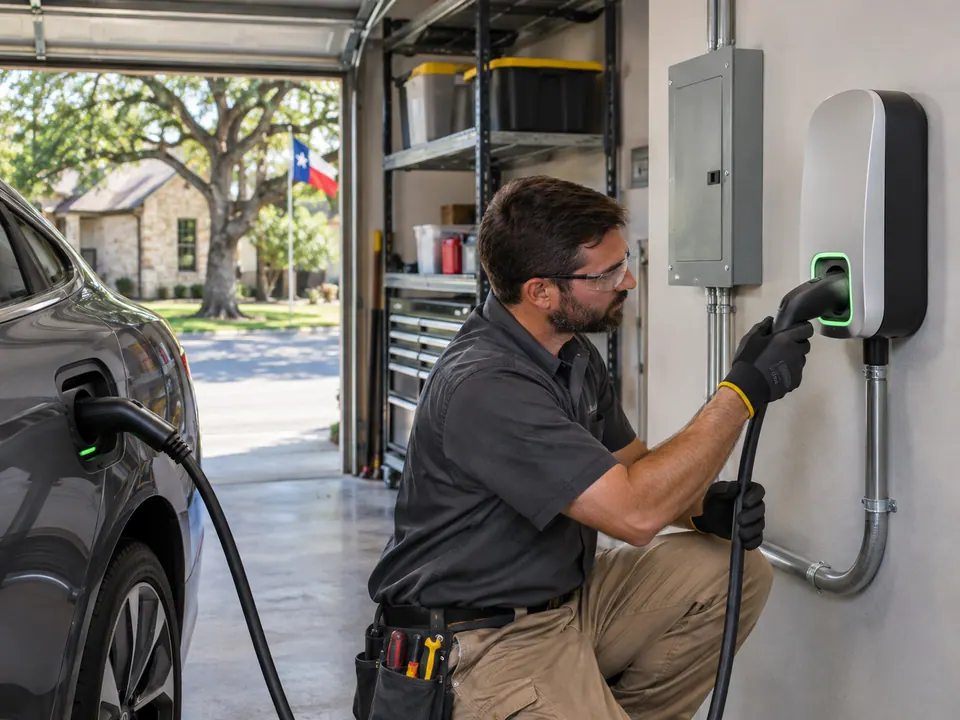
Start with how and where you park. The charger's cable should reach the vehicle's charge port without strain, and the wall or post must suit the selected equipment. The route from the electrical panel, existing loads, and charger instructions determine the circuit and installation method.
Tell us the vehicle and charger model, whether you charge in a garage or outside, and whether a 240-volt receptacle is already nearby. If the same project adds garage lighting, outlets, or other electrical equipment, a residential electrician in Arlington, TX can assess those loads alongside the charging plan. That avoids selecting a charger setting or circuit before the wider household demand is understood.
A practical charging plan
Choose the connection
Charging goals matter, but the equipment and electrical system set the workable options.
A vehicle's 120-volt cord may be enough for some overnight routines. The outlet and circuit still need to suit the equipment; a household receptacle should not be assumed ready for prolonged charging.
A plug-in unit needs the receptacle type and branch circuit specified by its manufacturer. The charger setting must match the circuit, and a 240-volt outlet elsewhere in the garage may have a different purpose or rating.
A wall unit can connect directly to a suitable circuit. This may suit outdoor placement or a model and output setting that does not support a plug-in connection. The installation follows the selected product instructions.
Before the charger goes on the wall
A charger is a sustained electrical load, so an open breaker space by itself does not establish available capacity. The electrician reviews existing loads, the proposed charger setting, and the panel and service equipment before deciding what circuit is appropriate. A panel upgrade is not automatic; if one is needed, upgrading the electrical panel becomes a separate part of the project.
The route from the panel to the charging location affects both work and cost. Share whether the charger will be inside or outside, which side of the car faces the wall, and where the vehicle's charge port is. Check that the equipment connector and any vehicle adapter fit the car before installation. If a model uses Wi-Fi or scheduled charging, its setup requirements should be reviewed too.
Existing electrical demand determines what charging output the home can support.
Panel distance, walls, access, and the mounting surface shape the installation.
Confirm cable reach, connector or adapter, and the product's rated location.
How the project begins
Have the vehicle and charger details ready so the electrical work can be assessed accurately.
Provide the vehicle, charger model, parking spot, and whether you prefer a hardwired unit or a specified receptacle.
An electrician checks the panel, household loads, circuit requirements, and a practical wiring path to the charging location.
Agree on the scope and price before work begins. The completed connection and charger operation can be checked with the selected equipment.
Service areas
Call about a home charger installation in Arlington or another community we serve.
View all service areas →Helpful answers
Answers to common decisions before installing home charging equipment.
Not always. Available capacity depends on the home's existing loads, panel and service equipment, and the charger's planned output. An electrician assesses those conditions before recommending a circuit or panel change.
Share its exact model, installation instructions, and intended location. The electrical supply, mounting, connection method, and vehicle connector must fit that particular unit.
Not by itself. The outlet type, circuit rating, wiring, condition, and the charger's instructions and settings must be compatible. A dryer or other appliance receptacle should not be assumed suitable for charging.
Both may be possible for some models. The manufacturer's allowed connections, desired output, location, and local electrical requirements guide the choice. Some settings or outdoor conditions may favor a hardwired installation.
Often, if the selected equipment and electrical fittings suit the exposure and a practical wiring and mounting location exists. The charging cable must still reach the parked vehicle safely.
Compatibility depends on the exact Wall Connector model, your vehicle's charge port, and any supported adapter. Check both product manuals before purchasing or installing equipment.
The cost depends on the charger, electrical capacity, panel-to-charger distance, wiring access, mounting location, and any needed circuit or service work. Ask for a scope based on your actual equipment and home.
That is a troubleshooting request, not a new-installation decision. Stop using equipment that reports a fault and provide the exact message, charger model, and when it appears so the charger and electrical supply can be assessed.