
Clicking or Rattling
A repeated tick may come from a blade, bracket, light kit, or another loose part. Note whether it changes with fan speed or only appears when the light is on.
Existing fan problems
World Class Electric, LLC helps Arlington homeowners and businesses with ceiling fans that click, grind, wobble, run slowly, or stop. A noise or loss of speed does not identify the failed part by itself. An electrician can check the fan's mounting, blades, controls, electrical supply, and internal components to find the cause before recommending a repair or replacement. Tell us what the fan does, when the problem started, and whether its light still works.
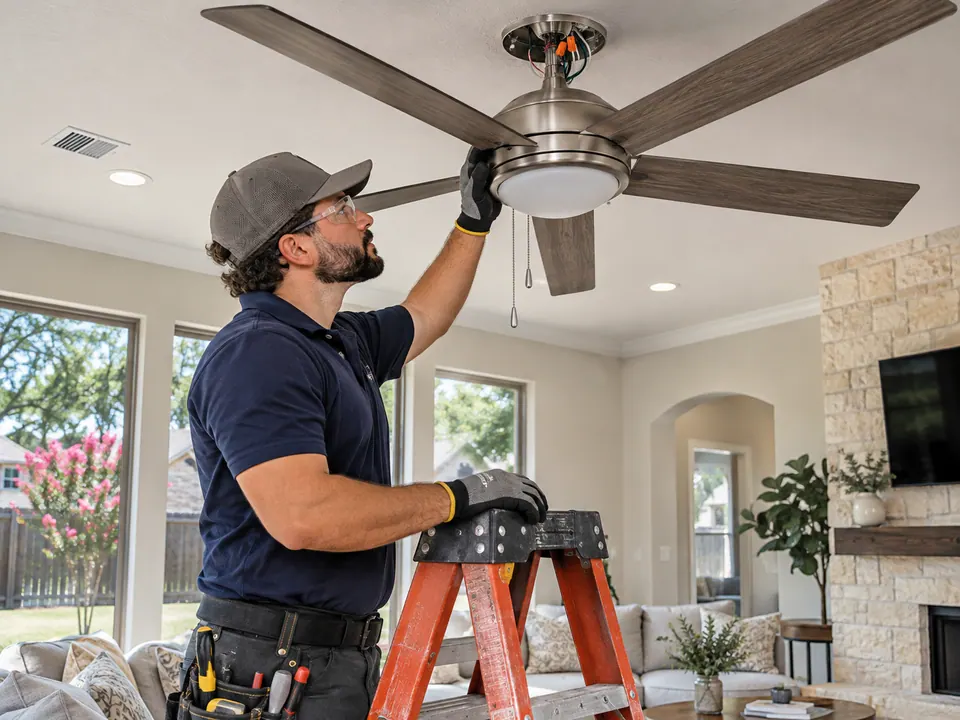
Find the cause first
The same symptom can come from different places. A clicking sound may involve a loose blade or light component, while a fan that will not start may have a control, power, or internal fan fault. The electrician checks the relevant parts and connections before deciding which work makes sense.
Note whether the fan responds at any speed, whether its light and remote work, and whether the issue began after a switch change or power interruption. If nearby lights or outlets also stopped working, an Arlington electrical contractor can assess the shared electrical supply instead of assuming the fan itself has failed. These details help narrow the first checks without guessing at a replacement part.
Problems we check
Describe what you hear, see, and feel. Similar signs can have more than one cause.
A repeated tick may come from a blade, bracket, light kit, or another loose part. Note whether it changes with fan speed or only appears when the light is on.
A rough sound can point to contact between parts or a problem inside the fan. Stop running a fan that scrapes or appears unstable until it has been checked.
Blade balance, mounting hardware, and the ceiling support can all affect movement. A fan that looks loose at the ceiling needs attention before continued use.
Speed-control, electrical, or internal fan problems can leave the motor humming or the blades moving weakly. The control and fan model matter to the diagnosis.
A stopped fan may have lost power, have a failed wall or remote control, or have an internal fault. Check whether other devices on the circuit still work and tell us what you find.
A working light does not prove the fan motor has power or that its speed control is sound. The fan and light may use separate controls or internal connections.
A careful diagnosis
Different symptoms, different checks
The visible symptom guides the inspection, but it does not settle the diagnosis.
When the fan shakes or clicks, the blade hardware, bracket, ceiling box, and support need review. Tightening a blade alone will not fix an insecure mounting point.
If the fan ignores a command, the wall control, remote battery or pairing, receiver, and compatible speed setting may need checking. A failed switch has a different repair from a failed motor.
Intermittent operation or a sudden stop may involve the circuit, switch wiring, or connections at the fan. A breaker trip or other dead devices can point beyond the ceiling fixture.
A motor, capacitor, or model-specific component may be at fault after power and controls are ruled out. Part availability and the fan's condition help determine whether repair is practical.
Repair or replace
A loose light shade, blade issue, or replaceable control may call for a focused repair. A damaged motor, unavailable part, or unsafe mounting setup may change the recommendation. The fan's model, condition, and the total work needed matter more than its age alone.
If replacement is the sensible choice, installing a new ceiling fan includes checking the support box, wiring, and controls for the selected model. Ask for both the repair scope and replacement scope when the decision is close.
The fault is identifiable, the necessary part is available, and the fan and support are otherwise sound.
The fault is extensive, a compatible part cannot be found, or the existing unit is in poor overall condition.
Turn off a fan that scrapes, shifts at the ceiling, gives off a burning smell, or has damaged wiring.
How the work begins
Share the behavior and model if available; the repair depends on what the inspection finds.
Tell us about the noise, wobble, speed, light, and controls. Mention whether other lights or outlets are affected.
An electrician checks the likely source, including mounting, controls, wiring, and internal components as the symptoms warrant.
Discuss the findings, repair scope, parts, or replacement before work begins. The fan and its controls can be tested after the agreed work.
Service areas
Call about an existing fan problem at a home or business in Arlington or another community we serve.
View all service areas →Helpful answers
Practical answers before you request help with a noisy or stopped fan.
A loose blade screw, bracket, light component, or other part may click as the fan turns. The sound's timing and location help guide a check, but the cause must be inspected before recommending a repair.
Turn it off until the cause is checked. A part may be rubbing, or the fan may have a mechanical fault. Stop using it especially if it also wobbles or shifts at the ceiling.
Uneven blades, loose blade hardware, an incorrect mounting arrangement, or an insecure ceiling support are possible causes. A visibly loose fan should stay off until its mounting is checked.
The light and fan may use separate controls or connections. The speed control, remote receiver, internal fan parts, and supply to the motor may need checking before the fault is clear.
Sometimes. The problem may involve a control, capacitor, connection, or motor, depending on the model. An inspection can establish the fault and whether a compatible repair part is available.
A remote battery, pairing issue, receiver, wall switch, or fan component can keep the unit from responding. Share the fan model and explain whether the light or any fan speed still works.
It depends on the fault, overall condition, part availability, and the cost of the required work. A minor control or blade issue differs from a damaged motor or unsafe mounting point.
The cost depends on what has failed, access to the fan, and whether a compatible part is needed. Describe the symptoms and model, then ask for the repair scope and price after the cause is identified.